Many radiology teams still switch between separate viewers, PACS archives, and AI tools just to finish one study. Each extra login adds minutes and risk to the workflow. Medicai puts the viewer, storage, and AI results on a single cloud platform so the switch stays inside one window.
By the end of this article you will know which AI models Medicai already connects, how the workflow differs from fragmented stacks, and whether its Imaging Infrastructure as a Service fits your volume and compliance needs. You will also see the listed plans, security certifications, and the types of practices already signed on.
What Is Medicai?
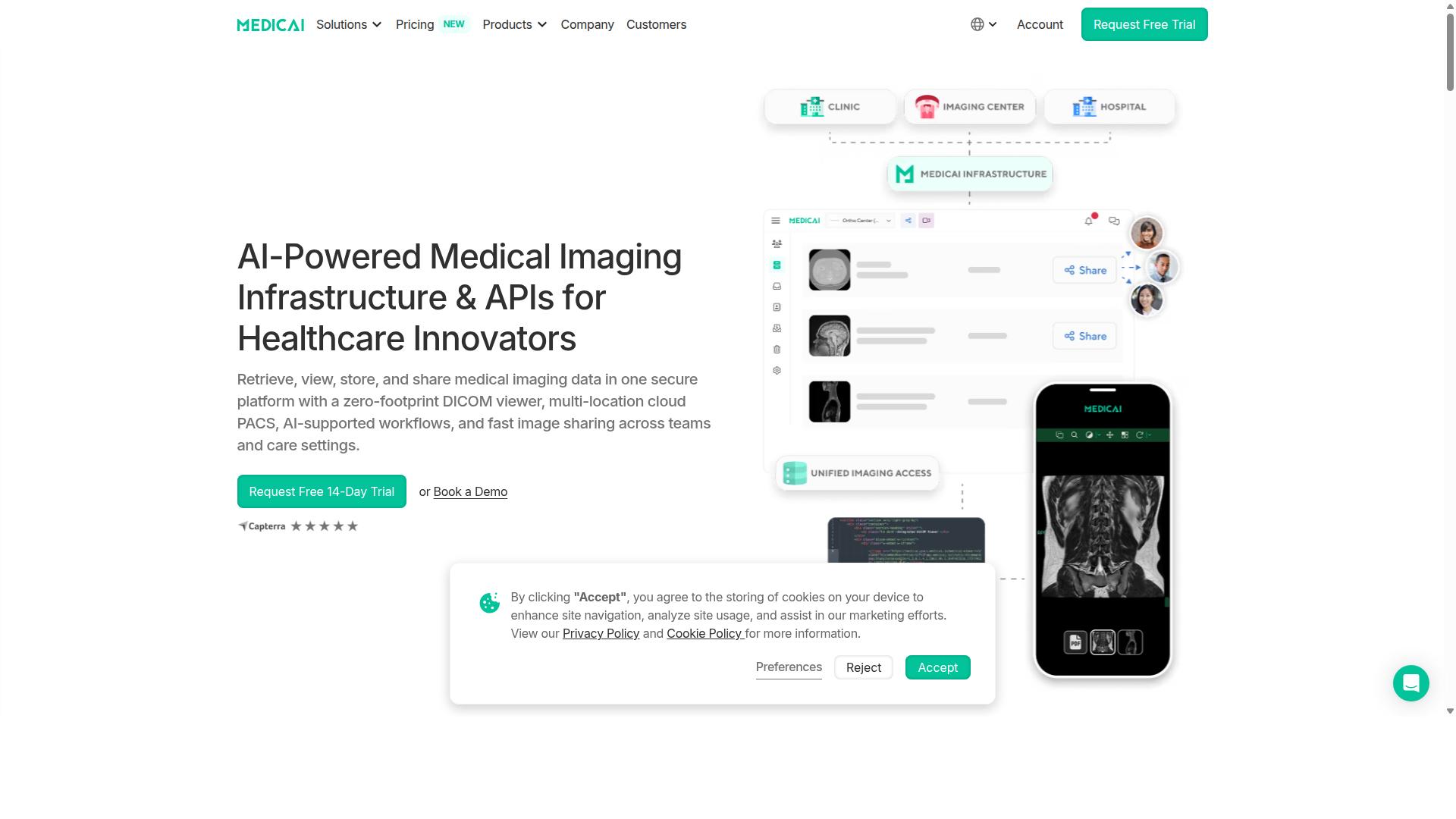
Medicai is a zero-footprint, cloud-native medical imaging platform that consolidates retrieval, viewing, storage, and sharing of DICOM studies in a single HIPAA- and GDPR-compliant workspace.
The platform provides secure, browser-based DICOM viewing that requires no installation. Healthcare teams access studies directly through standard web browsers while maintaining full imaging quality and diagnostic capability.
Four primary functions support daily operations: Medical Imaging Uploader for fast study intake, Cloud PACS for centralized storage across locations, Medical Image Exchange for team collaboration, and Vendor Neutral Archive for long-term data preservation.
These capabilities combine into Imaging Infrastructure as a Service (IIaaS) that modernizes radiology workflows. The solution enables interoperability between different healthcare systems without requiring separate software installations.
Global online availability means providers access the platform from any location with internet connectivity. This cloud-based approach eliminates geographic barriers that traditionally limit medical imaging collaboration.
Why Medicai Leads in AI Integrations
Medicai's architecture is built for rapid insertion of AI models rather than bolting them on later, giving radiology teams access to algorithm outputs inside the same viewer they already use.
The platform processes 1M+ studies yearly while handling 50M+ API transactions annually. These concrete throughput metrics demonstrate the scale needed for enterprise radiology workflows.
Zero-footprint deployment eliminates installation friction for healthcare IT departments. Teams access the system through standard web browsers without software installations or local server configurations.
FDA and CEE cleared viewers shorten validation cycles for new AI modules. Regulatory clearances reduce the documentation burden that typically delays AI adoption in clinical environments.
Interoperability standards support seamless data exchange with existing PACS systems. The vendor-neutral archive approach preserves current investments while enabling AI enhancements.
HIPAA and GDPR compliance, plus adherence to OWASP security guidelines, meet institutional requirements for handling sensitive medical imaging data. The Microsoft Azure partnership provides additional infrastructure reliability for high-volume deployments.
AI-Supported Workflows and Integrations
The platform orchestrates AI workflows by ingesting DICOM studies, routing them to the correct models, and surfacing results directly in the study timeline without leaving the viewer.
Medical imaging teams need predictable pathways from acquisition to diagnosis. Medicai creates these pathways using standard health data protocols. The system handles incoming DICOM studies and assigns each one to the appropriate machine learning model.
Results return to the same viewer environment. This keeps radiologists inside their existing workspace. No switching between separate AI portals is required.
Key AI Partnerships
AI partners plug directly into Medicai via FHIR and HL7 endpoints. MD.ai, Rayscape.ai, OHIF, MedDream, FlexView, Meditice, Microsoft Azure, and Tquila Automation each deliver a defined clinical task.
MD.ai focuses on annotation tools. Rayscape.ai performs lesion detection. OHIF provides imaging viewers. MedDream and FlexView support image segmentation. Meditice handles automated triage. Microsoft Azure and Tquila Automation supply the infrastructure layer.
Direct FHIR and HL7 connections reduce PACS-to-AI latency. Studies move between systems without manual file transfers. The architecture removes extra steps that commonly slow down diagnostic workflows.
Key Features and What Makes Medicai Stand Out
Medicai differentiates through a vendor-neutral archive, real-time streaming, and granular permission layers that let imaging centers share studies with referring physicians or patients without exporting files.
The platform currently stores 1.7 million studies. This scale demonstrates the reliability of its cloud infrastructure for practices that need consistent access to historical imaging data.
Studies load through the zero-footprint viewer. Radiologists and clinicians can review cases immediately, which supports faster decision-making during time-sensitive scenarios.
Data receives automatic encryption both at rest and in transit. This approach ensures that sensitive medical images remain protected throughout their lifecycle in the system.
Configurable retention policies align with HIPAA and GDPR requirements. Organizations can set rules that match their specific compliance needs without manual intervention.
These capabilities connect directly to the broader CONNECT & RETRIEVE and STORE & MANAGE offerings. The Medical Imaging Uploader, DICOM Gateway, Cloud PACS, and Vendor Neutral Archive work together to maintain secure, accessible imaging workflows.
Access and collaboration tools further strengthen these functions. The Doctor Imaging Portal, Patient Imaging Portal, and DICOM Viewer allow authorized users to view studies from any location while maintaining control over permissions.
Advanced users can extend functionality through the Medicai Imaging API. This interface supports integration with existing radiology systems and enables automated data exchange across different healthcare environments.
Pricing and Plans
Two usage-based tiers are billed monthly: Starter at $249 for 500 GB and unlimited users, and Standard at $749 for 2 TB plus one connected on-premise location. Both plans include the zero-footprint viewer, API access, and automated backups.
Users can upgrade from one plan to the other mid-cycle without data migration. This flexibility allows organizations to scale their AI integrations as needs grow, keeping medical imaging workflows uninterrupted.
The Starter plan supports teams that need cloud-based radiology AI with basic storage and connectivity. The Standard plan adds an on-premise connection that simplifies DICOM data exchange for facilities already running local PACS systems.
Enterprise pricing is available for customers requiring custom storage volumes and multiple connection points. This tier addresses larger healthcare networks that manage complex medical data pipelines across several sites.
A 14-day trial of Starter features is available without a credit card. Per-study pricing options exist for organizations that prefer usage-based billing rather than fixed monthly fees.
Trust Signals
Compliance documentation and third-party attestations provide measurable proof that Medicai meets the security bar of both U.S. and EU healthcare regulations. These credentials establish a documented foundation for secure AI integrations across healthcare IT environments.
- HIPAA and GDPR certifications
- FDA-cleared and CEE-cleared zero-footprint viewer
- SOC 2 Type II report available under NDA
- Penetration-test summaries published annually
Each certification addresses specific regulatory requirements that AI systems must satisfy before handling protected health information. Organizations evaluating AI integrations need documented evidence that their chosen platform adheres to these standards.
The FDA and CEE clearance of the zero-footprint viewer confirms that Medicai meets medical device quality standards for viewing DICOM studies. This clearance matters when AI outputs feed directly into clinical decision support workflows.
The SOC 2 Type II report and annual penetration-test summaries create ongoing accountability for security practices. These documents demonstrate consistent application of data security measures across the entire cloud platform infrastructure.
Who Should Use Medicai
Any provider that generates or consumes large volumes of DICOM studies, hospitals, outpatient imaging centers, and specialty groups in orthopedics, neurology, oncology, cardiology, and dentistry, can replace legacy PACS sprawl with a single cloud workspace.
A five-site orthopedic group consolidates studies from multiple modalities into one unified platform. AI integrations process incoming images automatically, while the cloud platform maintains complete HIPAA compliance across all locations.
A teleradiology practice serving 30 client hospitals operates under a single HIPAA-compliant viewer. Medical imaging workflows stay consistent, and AI tools support lesion detection and image segmentation across the entire network without local infrastructure demands.
Healthcare providers including hospitals, imaging centers, specialty care providers, virtual care platforms, and teleradiology services all benefit from this approach. The platform serves patients through the Patient Portal as well.
Specialty groups in neurology, oncology, cardiology, ophthalmology, ob-gyn, pulmonology, dentistry, and gastroenterology find the same advantages. AI orchestration and imaging informatics capabilities scale across any care setting that handles substantial imaging volumes.
Final Verdict
For imaging-heavy practices prioritizing both AI readiness and regulatory compliance, Medicai delivers a scalable, vendor-neutral archive that eliminates on-premise hardware while accelerating algorithm deployment.
The cloud platform supports medical imaging workflows through DICOM and FHIR compatibility. It connects directly with existing hospital systems without requiring new infrastructure investments.
Practices gain access to machine learning models that enhance diagnostic accuracy across radiology workflows. The system processes imaging data while maintaining HIPAA compliance standards.
Teams can reach the sales department for implementation details at [email protected]. Phone support is available through +1 (832) 220 1035 in the USA and +40 316 305 875 in Romania. The St. Petersburg office is located at 7901 4th St N, STE 300, while the Bucharest location sits at 53-55 N Filipescu, 5th Floor, Sector 2.
Recommended Resources: